Operation Firewall

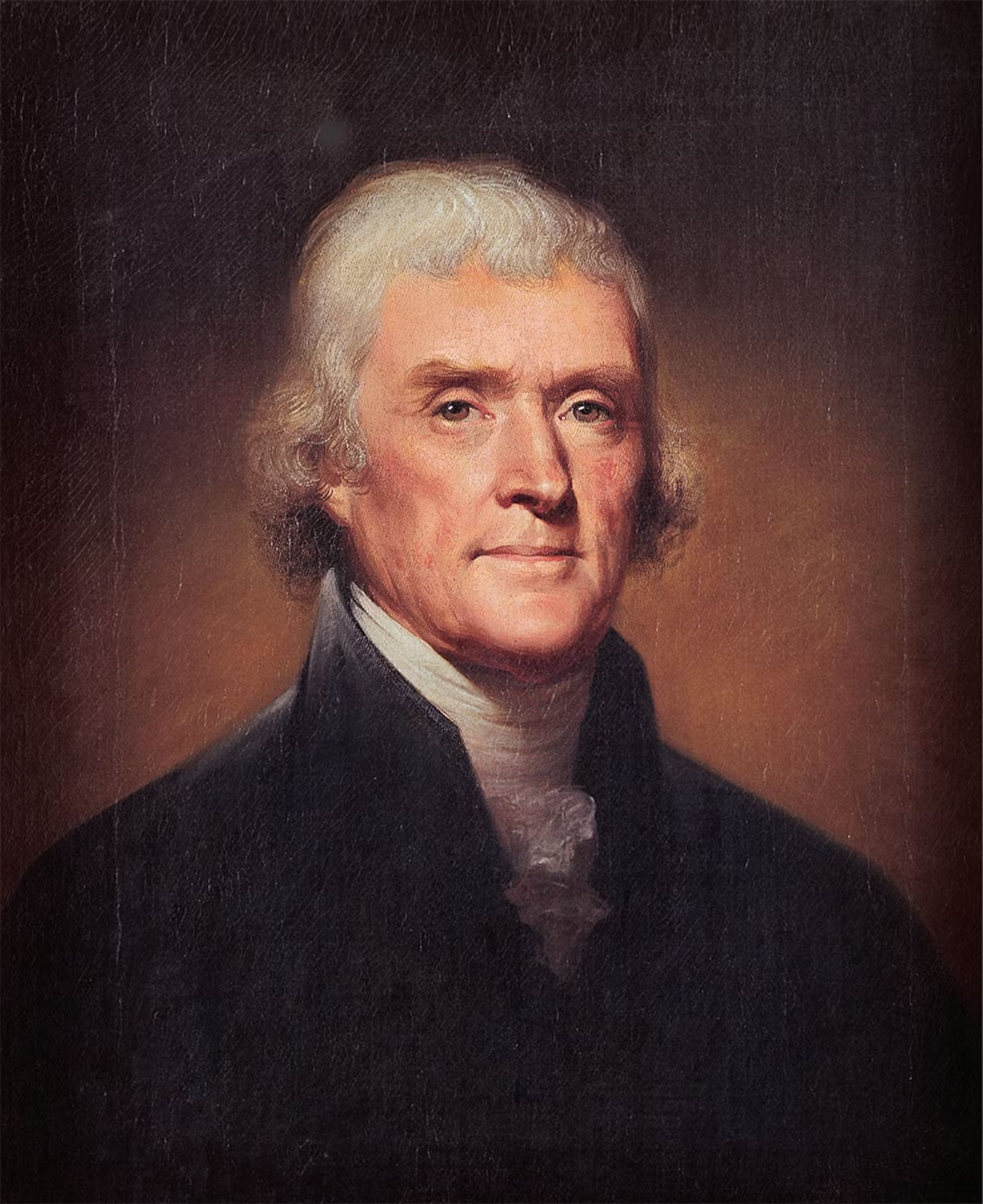
“The two enemies of the people are criminals and government; so let us tie the second down with the chains of the Constitution so it will not become the legalized version of the first.”
Thomas Jefferson
Founding Father

OPERATION FIREWALL

Operation Firewall represents a formal mechanism for the American people to audit, quietly and methodically, their servants in every branch, restoring the Constitution’s original fence around power. In courtrooms, council chambers, and even CPS hearings, citizens carry only a yellow pad and mark each breach, the judge who rules without a jury, the legislator who authors ultra vires law, and the executive who seizes without probable cause, and the chain is reforged. Each tick is lawful notice; each affidavit self-executes under the 11 Immutable Principles, building an irrefutable docket no servant can ignore. This is not activism; it is constitutional hygiene. The creature returned to its cage. As Madison wrote, “The Constitution is but parchment; its efficacy depends upon the auxiliary precautions of those who have it in their power to enforce it.” That power is yours.

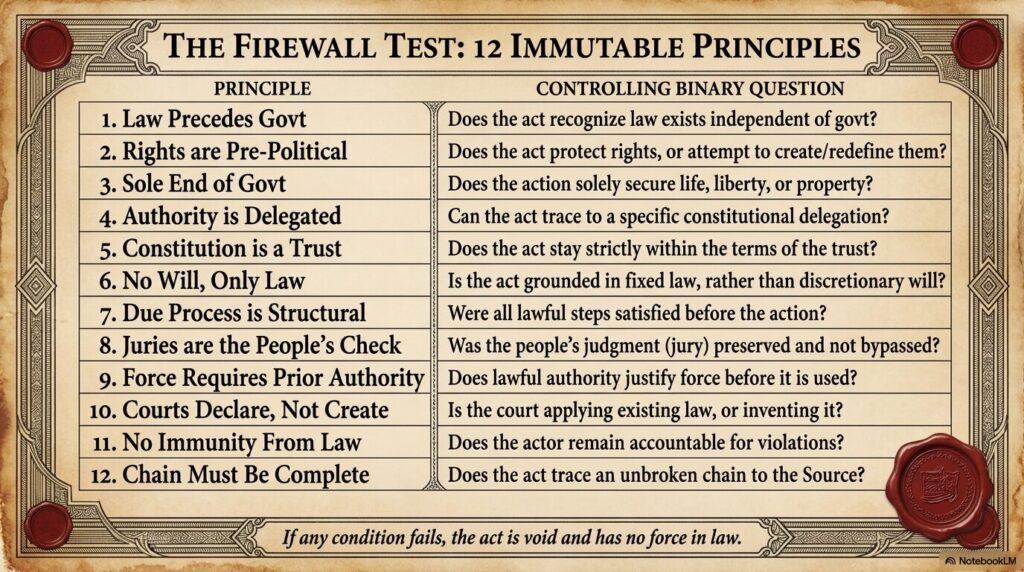
THE FIREWALL: 11 IMMUTABLE PRINCIPLES OF AMERICAN LAW AND GOVERNANCE

The Firewall constitutes a set of eleven axiomatic principles, drawn from common law maxims and constitutional fundamentals. Any act-legislative, executive, or judicial-effecting a breach of these principles is ipso facto void ab initio, carrying no lawful force regardless of the agent’s title or procedural posture. The organism known as government remains bound; its departures do not amend the boundaries, they annul the departure itself.

THE LAW OF NATURE IS SUPREME, IMMUTABLE, AND FIXED, REIGNING ETERNALLY OVER EVERY HUMAN INSTITUTION. NO ACT, STATUTE, OR DECREE CAN OVERRIDE WHAT GOD HAS ORDAINED.

The law of nature, coeval with mankind and dictated by God Himself, reigns eternally over every human institution. No act, statute, or decree can override what God has ordained. As Blackstone declared, it is “superior in obligation to any other.” The Law of God cannot be degraded, amended, or voided— “Whatever I command thee, ye shall not add to nor take away from it” (Deut. 12:32). Things forbidden by the nature of things are confirmed by no law. When government defies this, it stands void. Branch, Prine. Reason is the life of the law—Coke. This is not theory. This is the first brick.

  1. True Law follows the following hierarchy: nature, maxims, constitutions, enactments.
  2. Law of revelation – God’s law – first, unchangeable. Blackstone, Commentaries on the Laws of England: “The divine law is of infinite authority… the moral precepts which God has given to mankind.”
  3. Fundamental Maxims of law – eternal, self-evident, beyond proof or discourse. Coke, Institutes of the Laws of England (1628), Id. 67a: “Propositions to be of all men confessed and granted without proofe, argument, or discourse… they are not to be disputed: they are the law of the land.”
  4. Constitutions of society – man’s written cage for government, only if they kneel to revelation and maxims. 
  5. Enactments – statutes, codes, rules. Cooley: “Enactments are not the law of the land, they are but the will of the legislature, subject always to the maxims and to reason.”

Evidence:

  1. Maxim: “We hold these truths to be self-evident, that all men are created equal, that they are endowed by their Creator with certain unalienable Rights” (Declaration of Independence).
  2. Maxim: “The law is a rule of right; and whatever is contrary to the rule of right, is an injury” (Vanhorne v. Dorrance, 3 Burr. 313).
  3. Maxim: “Individual liberties are antecedent to all government.” (C.L.M.)

William Blackstone affirms these rights cannot be surrendered, being safeguarded by declaratory and restrictive clauses in state constitutions. No human law can override what God ordained.

  1. Evidence:
    1. “The sole object and only legitimate end of government is to protect the citizen in the enjoyment of life, liberty, and property; when it assumes any other function, it is usurpation and oppression.” (Alabama Constitution, Art. I, § 35)
    2. “Government is instituted for the common good; for the protection, safety, prosperity and happiness of the people, and not for the profit, honor, or private interest of any one man, family, or class of men.” (Massachusetts Constitution, Pt. 1, Art. VII)
    3. “The main object of government is the protection and preservation of personal rights, private property, public liberties, and the upholding of the law of God.” (American Maxim)
    4. “Men… by common consent agree to form a community for their mutual preservation… and if anyone shall attempt to destroy or invade this property, the community may defend itself.” (Locke, Second Treatise, § 135)

When government betrays this purpose, it forfeits legitimacy and invites the people’s correction.

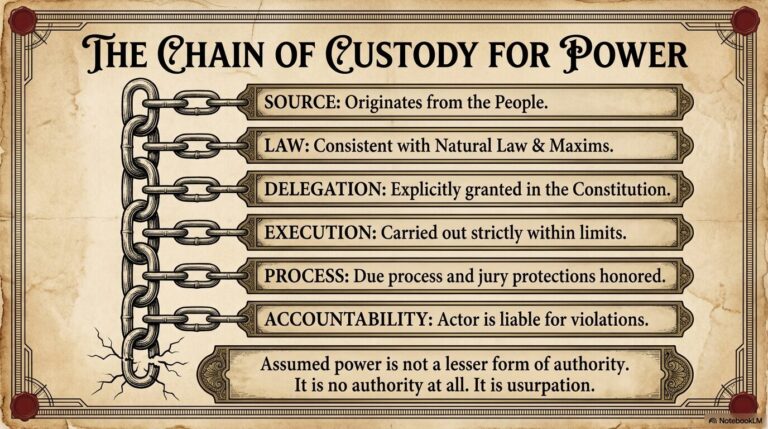
Such a grant is governed by five immutable rules:

  1. Only what the people possess can be granted. Maxim: If a man grants that which is not his, the grant is void. Shep. Touch. 243; Watk. Conv. 191 (2)
  2. Delegated power cannot be redelegated. Maxim: “A delegated power cannot be again delegated.” 2 Inst. 597; Black’s, 2d. 347; 2 Bouv. Inst. n. 1300.
  3. Derivative power cannot exceed the original. Maxim: “The derivative power cannot be greater than the original from which it is derived.” (Noy, Max.; Wing. Max. 66; Finch, Law, b. 1, c. 3.)
  4. Power not expressly granted has no authority. Maxim: “Where there is no authority for establishing a rule, there is no necessity of obeying it.” (Black’s, 2d. 1181; Dav. Ir. KB. 69.)
  5. Presumptions, adhesion contracts, and implied consent are void. When the People never granted a power, it never existed. Maxim: “Nothing is so becoming to authority as to live in accordance with the laws.” Fleta, lib. 1, c. 17, s. 11.

Further Evidence:

  1. “The powers delegated by the proposed Constitution to the federal government are few and defined.” (Madison, Federalist 45)
  2. “All power exercised over a nation must have some beginning. It must either be delegated or assumed. There are no other sources. All delegated power is trust, and all assumed power is usurpation.” (Thomas Paine, Common Sense)
  3. “If in a limited government, the public functionaries exceed the limits which the constitution prescribes to their powers, every act is an act of usurpation, and as such, treason against the sovereignty of the People.” (St. George Tucker, Blackstone’s Commentaries (Vol. 1, Appendix Note B, Section 3, 1803))


Evidence:

  1. “All executive and judicial Officers, both of the United States and of the several States, shall be bound by Oath or Affirmation, to support this Constitution.” (U.S. Constitution, Art. VI, Cl. 3)
  2. “All officers “shall take and subscribe the following oath… to faithfully and impartially discharge and perform all the duties incumbent on me.” (Massachusetts Constitution, Pt. 2, Ch. VI, Art. I)
  3. “The members and officers of the State governments… will be bound by the sanctity of their oaths to the federal Constitution… to prevent arbitrary actions.” (Federalist No. 44 Madison)
  4. Maxim: “Public office is a public trust.” – Officers are trustees, not rulers, and must serve the people’s interest.
  5. Maxim: “No man ought to be a judge in his own cause.” (Jenk. Cent. Cas. 126)—Self-interested acts violate the oath.
  6. Maxim: “There is no stronger link or bond between men than an oath.” (Jenk. Cent. Cas. 126, case 54) – The oath binds irrevocably.\
  7. Maxim: “It is immaterial whether a man gives his assent by words or by acts and deeds.” (10 Coke, 52) – Actions contrary to the oath are betrayal. When officials break this sacred bond, they do not merely err, they rebel against the People’s trust. Their authority vanishes the moment the oath is broken.

Evidence:

  1. “Whenever the ends of Government are perverted, and public liberty manifestly endangered, and all other means of redress are ineffectual, the People may, and of right ought, to reform the old, or establish a new Government…” (Maryland Constitution, Art. I, Sec. 6)
  2. “Who shall be judge, whether the prince or legislative act contrary to their trust? … The people shall be judge…” (John Locke, Second Treatise, § 240)
  3. “Whenever any Form of Government becomes destructive of these ends, it is the Right of the People to alter or to abolish it…” (Declaration of Independence)
  4. “The tree of liberty must be refreshed from time to time with the blood of patriots and tyrants.” (Thomas Jefferson, Letter to William Stephens Smith, 1787)
  5. “The ultimate authority… resides in the people alone…” (Federalist No. 46, Madison)


Evidence:

  1. “No person shall be held to answer for a capital, or otherwise infamous crime, unless on a presentment or indictment of a Grand Jury…” (U.S. Constitution, Fifth Amendment)
  2. “No subject shall be… deprived of his life, liberty, or estate, but by the judgment of his peers, or the law of the land.” (Massachusetts Constitution, Part the First, Art. XII)
  3. “Everything in this ‘Bill of Rights’ is excepted out of the general powers of government and shall forever remain inviolate.” (Texas Constitution, Art. 1, § 29)
  4. John Adams (1779): “The grand jury is a security to the subject against unfounded accusation; it is a check upon the government, not a servant of it.” (Massachusetts Historical Society, Adams Papers)
  5. “The grand jury is a security against hasty and oppressive prosecutions… it is the people’s protection against the abuse of power.” (Alexander Hamilton, Federalist No. 83)
  6. “No free man shall be deprived of life, liberty, or property but by the lawful judgment of his peers…” (Magna Carta, Ch. 39
  7. Justice Scalia: “The Fifth Amendment creates a fourth branch—the jury—outside the government.” (Blakely v. Washington, 542 U.S. 296, 2004)
  8. Maxim: “Nemo accusatur nisi per judicium parium suorum” – No one is accused except by the judgment of their peers.
  9. Maxim: “Due process of law in every case means only those powers the settled maxims of law permit and sanction.” The grand jury indicts, the petit jury convicts—both are the People’s voice, not the state’s tool. Any delegation to judges or officials is usurpation, null and void.


  1. Evidence:
    1. “A court can only declare what the law is and whether consistent with the law of God and the fundamental or constitutional law of society.” (The State v. Post, 20 N.J.L. 368, 370, 1845)
    2. “The judicial shall never exercise the legislative and executive powers, or either of them…” (Massachusetts Constitution, Part the First, Art. XXX)
    3. “Nothing in law is more intolerable than that the same case or matter should be subject (in different courts) to different views of the law.” (4 Coke, 93)
    4. “The judiciary must apply the law as it stands, not extend its reach beyond the trust reposed in it, lest it encroach upon liberty.” (John Locke, Second Treatise, § 136)
    5. “The judiciary power ought not to be united with the legislative… lest the same judge make and apply laws, becoming a tyrant.” (Montesquieu, The Spirit of the Laws)
    6. “In that sense alone [original meaning], it is the legitimate Constitution… If that be not the guide, there can be no security for a consistent and stable government.” (James Madison, Letter to Henry Lee, 1824)
  1. Evidence:
    1. “In republics, the great danger is, that the majority may not sufficiently respect the rights of the minority… The law is the rule, and it is immutable.” (Montesquieu, The Spirit of the Laws)
    2. “Let us disappoint the men who are raising themselves upon the ruin of this country.” (John Adams, Letter to Abigail Adams, 1776)
    3. “The United States shall guarantee to every State in this Union a Republican Form of Government…” (U.S. Constitution, Art. IV, § 4)
    4. “The fundamental maxims of a free government… are so simple and so important that they are taken for granted without proof.” (James Wilson, Lectures on Law, 1791)
    5. Maxim: “Lex non scripta, lex naturalis”, The unwritten law is the natural law, binding above all statutes.

When government defies this hierarchy, it ceases to be republican. The people demand its restoration.

Evidence:

“for rebellion being an opposition, not to persons, but authority, which is founded only in the constitutions and laws of the government; those, whoever they be, who by force break through, and by force justify their violation of them, are truly and properly rebels: for when men, by entering into society and civil government, have excluded force, and introduced laws for the preservation of property, peace, and unity amongst themselves; those who set up force again in opposition to the laws, do rebellare, that is, bring back again the state of war, and are properly rebels; which they who are in power, (by the pretence they have to authority, the temptation of force they have in their hands, and the flattery of those about them) being likeliest to do; the properest way to prevent the evil, is to show them the danger and injustice of it, who are under the greatest temptation to run into it.”(John Locke, Second Treatise, § 226) True rebellion is not the people’s resistance to tyranny, it is the betrayal of public officers who violate their oath. The Fourteenth Amendment, Section 3 declares: “No person shall be a Senator or Representative in Congress, or elector of President and Vice-President, or hold any office, civil or military, under the United States, or under any State, who, having previously taken an oath, as a member of Congress, or as an officer of the United States, or as a member of any State legislature, or as an executive or judicial officer of any State, to support the Constitution of the United States, shall have engaged in insurrection or rebellion against the same, or given aid or comfort to the enemies thereof.”

Evidence:

  1. “This clause is self-executing and requires no legislation to make it effectual.” (Senator James Grimes, Cong. Globe, 39th Cong., 1st Sess. 2544, 1866)
  2. “In that sense alone [original meaning], it is the legitimate Constitution… If that be not the guide, there can be no security for a consistent and stable government.” (James Madison, Letter to Henry Lee, 1824)
  3. “The people alone have an incontestable, unalienable, and indefeasible right to institute government, and to reform, alter, or totally change the same, when their protection, safety, prosperity, and happiness require it.” (Massachusetts Constitution, Part the First, Art. VII)
  4. “In order to prevent those who are vested with authority from becoming oppressors, the people have a right… to cause their public officers to return to private life.” (Massachusetts Constitution, Part the First, Art. VIII)
  5. “When legislators or rulers… endeavor to take away and destroy the property of the people, or reduce them to slavery under arbitrary power, they put themselves into a state of war with the people, who are thereupon absolved from any further obedience.” (John Locke, Second Treatise, § 227)
  6. “The people have a right, in an orderly and peaceable manner, to assemble to consult upon the common good; give instructions to their representatives…” (Massachusetts Constitution, Part the First, Art. XIX)
  7. Maxim: “One lawfully commanding must be obeyed.” (Jenk. Cent. 120)

When officers betray their oath, they are the rebels, disqualified instantly by the Fourteenth Amendment’s own force. The people, acting in orderly assembly, command their removal and the restoration of a republican government. This is not request; it is law.

The Constitution stands as an expression of immutable principles, truths rooted in the Law of Nature, divine authority, and the sovereign will of the People. These truths are eternal, fixed, and absolute. They are not subject to debate, interpretation, or convenience. No government, no judge, and no emergency can alter or override them. As John Adams declared, “A constitution is not a contract to be broken, but a covenant to be kept.” They are not opinions. They are not negotiable. They are, above all, the law. Any act contrary to them is not law at all but rebellion against the very foundation of liberty.

Sir Edward Coke, the great English jurist, affirmed that maxims hold “chiefest dignity and most certain authority, and because they are universally approved by all.” A maxim is a universal principle of law, so self-evident it is confessed and granted “without proofe, argument, or discourse.” To disregard immutable maxims is to invite deception, usurpation, and government encroachment, for without them there is no fixed compass of right and wrong. When officials twist the Constitution as opinion or treat it as optional, they abandon covenant for tyranny, trading law for arbitrary power.

The only way through the firewall is the lawful process of law that is due. Due process is not defined by statute, code, policy, regulation, or the will of man. Due process, synonymous with the law of the land and the common law, is sanctioned by the ancient maxims of wisdom. “Due process of law in each particular case means such an exercise of the powers of government as the settled maxims of law permit and sanction, and under the safeguards for the protection of individual rights as those maxims prescribe for the class of cases to which the one in question belongs.” This principle, rooted in common law and constitutional tradition, establishes that government actions must conform to longstanding maxims and immutable rules of right and justice, not arbitrary statutes or bureaucratic whims.

AUDIT CHECKLISTS

Welcome to the Audit Checklists Section

In this section of our website, we provide three downloadable audit checklists—each tailored to a distinct branch of government: the executive, the judicial, and the legislative. As the ultimate political authority resides in the people, these documents are designed to empower every citizen, “We the People”, to hold public officials accountable.

How to Use the Checklists:

  1. Download the Appropriate Checklist: Select the checklist that corresponds to the branch of government you are auditing—executive, judicial, or legislative.

  2. Document Violations: As you observe any infringement of rights or breaches of law, simply check off the corresponding boxes on the form.

  3. Complete and Sign: Once completed, sign the checklist along with two witnesses to attest to its accuracy.

  4. Submit Copies: Send a copy to the individual or office responsible for the violation, retain one for your own records, and if you choose, email a copy to notices@usgac.com. Upon receipt, if we receive at least three complaints regarding the same individual or office, we will not only open an investigation and file a formal complaint but also, if necessary, refer the matter to a grand jury.

In this way, we empower every citizen to be a guardian of their own liberties. We are all Publius; it is up to the People, in whom all political power resides.

EXECUTIVE BRANCH AUDIT CHECKLIST AND AFFIDAVIT

COMING SOON

LEGISLATIVE USURPATION AUDIT CHECKLIST AND AFFIDAVIT

COMING SOON

JUDICIAL PROCESS AUDIT CHECKLIST AND AFFIDAVIT

This is an 11-page document for documenting violations of constitutional, lawful, and natural due process in court proceedings. It functions as a checklist, lawful notice, and affidavit, requiring the filer to affirm status as one of the sovereign people under the 50 states' republican constitutions and demanding court officials (judge, clerk, sheriff, prosecutor) adhere to fundamental principles, maxims of law, and constitutional mandates.

REPORTS ON SYSTEMIC CORRUPTION AND CONSTITUTIONAL OVERREACH IN THE AMERICAN LEGAL SYSTEM

In this series of academic reports, we discuss the pressing issue of systemic corruption and constitutional overreach in the American legal system. Each report in this collection serves as a detailed indictment of a particular facet of legal overreach. For example, one report, “Corrupted Defender,” examines how legal counsel is often compromised, not delivering the constitutional protections one might expect. Another report, Replaced by Fiat, focuses on how courts have sidelined reason and constitutional principles. A third report offers a constitutional indictment of Child Protective Services through the lens of the Rivera case, presenting it as irrefutable proof of systemic nullity.

The purpose of these reports is not just to inform but to equip you, the reader, to spread awareness and to challenge these overreaches by asking a simple but powerful question: “By what authority?” We encourage you to share these reports widely and to use them as tools for initiating conversations about accountability and the restoration of constitutional governance.

Academic Synopsis: "The People’s Sheriff: Bulwark Against Tyranny, Common Law Origins, Modern Usurpation, and Immediate Restoration" (GAC w Review, Art. 2, 2025)

This is a 25-page comprehensive report arguing that the American sheriff's office is the oldest secular office in Anglo-American legal tradition, created by the people rather than statute, and that its common-law powers are constitutionally protected against legislative diminution. The author asserts that the sheriff is a bulwark against tyranny, rooted in natural law and maxims, with unalterable duties including protection of life, liberty, and property, and that modern requirements like mandatory bar association membership in nine states are unlawful subtractions of independence and allegiance to the People. The source critiques various usurpations, including the transformation of sheriffs into state deputies, statutory additions of duties that erode core functions, and the imposition of private guild oaths that violate titles of nobility prohibitions. Ultimately, the report concludes that the only remedy is for sheriffs to immediately restore the office through peaceful steps like rejecting bar requirements, resuming common-law powers, and enforcing the People's constitutions without legislative permission.

Academic Synopsis: "Immunity, The Undelegated Fraud: Why Government Cannot Lawfully Exempt Itself from Accountability" (GAC w Review, Art. 4, 2025)

This is a comprehensive analytical report arguing that the doctrine of governmental immunity in the American legal system is not a delegated constitutional power, but an unlawful, judicially-created fraud that systematically inverts the sovereign relationship between the People and their agents. The author asserts that all legitimate governmental power is a conditional trust , derived from the People's pre-political rights and defined by an immutable hierarchy of law. The source establishes that immunity is a form of usurpation rooted in the principle of casus omissus : the People's specific and limited grant of parliamentary privilege (Article I, Section 6) proves they withheld broad immunity from all other officials. The author relies on foundational authorities such as John Locke's forfeiture of trust , Thomas Paine’s definition of delegation , and centuries of common-law maxims (e.g., Ubi Jus Ibi Remedium and Quod Ab Initio Non Valet ) to argue that every immunity precedent (including landmark cases like Stump v. Sparkman and Pierson v. Ray) is void ab initio. Ultimately, the report concludes that the only remedy is restoration of the constitutional order by asserting that the creature that claims sweeping immunity has already dissolved itself.

Academic Synopsis: "The Immutable Jury: An Analysis of the Petit Jury's Authority Under the Unalterable Hierarchy of Law" (GAC Law Review, Art. 12, 2025)

This is a 16-page comprehensive report arguing that the modern American justice system has unlawfully dismantled and suppressed the historical common-law petit jury, replacing it with an unconstitutional administrative substitute. The author asserts that the jury, rooted in the Law of Nature and fundamental maxims, is an immutable institution requiring twelve unanimous members with the authority to judge both the facts and the law, and that modern deviations like six-person juries, non-unanimous verdicts, and judicial gag orders are void ab initio. The source critiques the widespread use of plea bargaining, which bypasses 99% of trials, and the reliance on opaque algorithmic jury-wheel software as systemic methods of control. Ultimately, the report concludes that the only remedy is for the People to reclaim and restore the fully informed, independent common-law jury, recognizing its inherent supremacy over all governmental branches.

Academic Synopsis: "The Grand Jury as a Pre-Political Institution: A Legal Analysis of Its Natural Law Foundation and Inherent Independence" (GAC Law Review, Art. 14, 2025)

This 20-page document provides a legal and philosophical critique of the modern grand jury system, arguing that it has been unconstitutionally captured by the executive branch and judiciary. The central thesis posits that the grand jury is a "pre-political institution" rooted in natural law and fundamental maxims like casus omissus, making it inherently independent of all three government branches. The text contends that any legislative or judicial regulation of the grand jury is void ab initio because the power to control it was never delegated by the people. Citing authorities like Blackstone, Hamilton, and Paine, the analysis contrasts the historical model—where the grand jury was the people’s check on government (a "sword and shield")—with the modern system, evidenced by high indictment rates and misleading juror handbooks, which serve only as a prosecutorial rubber stamp. The ultimate remedy proposed is the reclamation of the grand jury's original independence through citizen education and direct assembly.

Academic Synopsis: The Federal Reserve System: A Constitutional Indictment, Void Ab Initio" (GAC Law Review, Art.16, 2025)

This definitive report by Publius Custos provides a rigorous constitutional analysis of the American monetary system, arguing that the Federal Reserve operates as a "systemic nullity" outside the bounds of delegated authority. By applying the "Laws of Nature and of Nature's God," the document identifies four pillars of institutional illegitimacy that render the Federal Reserve Act void from its inception. The Four Pillars of Illegitimacy 1. The Usurpation of Monetary Sovereignty: Under the maxim Delegata potestas non potest delegari, a power delegated by the People to Congress cannot be further redelegated to a private banking guild. The report argues that Congress abandoned its exclusive constitutional duty to "coin Money" by handing the scepter of sovereignty to private interests. 2. The Substitution of Debt for Substance: The Constitution defines money strictly as gold or silver coin with intrinsic value (Article I, Sections 8 and 10). This report indicts the system for compelling the People to exchange labor for Federal Reserve Notes—statutorily defined "obligations" and liabilities that constitute debt rather than lawful money. 3. The Fraud of Positive Law (Title 12): Investigating the formal status of banking statutes, the report reveals that Title 12 of the U.S. Code has never been enacted into positive law. It remains merely prima facie evidence—an editorial compilation that lacks the mandatory enacting clause required to move from the "will of the legislature" to the "law of the land". 4. The Doctrine of Void Ab Initio: Drawing on authorities such as Blackstone, Coke, and Cooley, the report asserts that acts taken without delegated authority are not merely unconstitutional—they are a nullity. Citing Norton v. Shelby County, it argues that no amount of time or "administrative despotism" can validate a system born from a jurisdictional vacuum. Key Historical Insights The Jekyll Island Conspiracy: Documents the 1910 secret meeting where private financiers drafted the framework for the Fed to intentionally evade public scrutiny. The McFadden Indictment: References the 1932 testimony of Congressman Louis T. McFadden, who formally put the government on notice regarding the "corrupt practices" of the Federal Reserve. The Seizure of 1933: Analyzes the "manufactured" banking crisis used to justify the unconstitutional confiscation of the People's gold. "Where the law ends, tyranny begins." This report serves as a formal notice to all agents: the "written cage" of the Constitution is empty of the power you claim. Continued enforcement of this void system constitutes a willful act of usurpation and a continuing trespass against the sovereign People.

Academic Synopsis: "Betrayed by Counsel: The Corrupted Defender" (GAC Law Review, Art. 20, 2025)

This 12-page document indicts the American legal system for systemic usurpation, identifying four pillars of illegitimacy:(1) the bar association's monopoly on counsel, creating divided loyalty that violates the Sixth Amendment by requiring attorneys to prioritize court and bar obligations over clients; (2) the unauthorized office of public prosecutors, which lacks constitutional basis and usurps the people's right to initiate accusations via grand juries; (3) civil asset forfeiture as institutionalized theft without due process, void under maxims like delegata potestas non potest delegari; and (4) judicial contempt powers as arbitrary intimidation, exceeding Article III limits and state constitutions. It cites historical authorities like Blackstone, Coke, Cooley, and cases such as Glasser v. United States (1942) to argue these practices constitute treason against popular sovereignty.

Academic Synopsis: "Replaced by Fiat: When Courts Expel Reason, The Constitution, and True Law " (GAC Law Review, Art. 22, 2025)

This piece, authored by Publius Custos, flatly states that federal and state courts have abandoned constitutional law for fiat rulings, violating Article III by sidelining juries and embracing equity over common law principles. It lists specific acts—like denying jury trials in civil cases, ignoring due process, and bypassing constitutional text—as clear breaches of the Constitution, with no ambiguity in their illegality under original intent. The author cites historical cases, like misapplied ones, to prove courts have self-expanded power, eroding the people's sovereignty. Operation Firewall is presented as a lawful fix, using affidavits and grand juries to enforce constitutional limits, grounded in unassailable legal tradition. No subjectivity here-just the document's claims of objective constitutional violations and a structured remedy.

Academic Synopsis: "A Constitutional Indictment of Child Protective Services: The Rivera Case as Irrefutable Proof of Systemic Nullity" (GAC Law Review, Art. 24, 2025)

This article establishes that Child Protective Services (CPS), including Massachusetts DCF, is constitutionally void ab initio, lacking any delegation of authority from the sovereign people under the immutable hierarchy of law: Laws of Nature and Nature’s God, fundamental maxims, constitutions, and enactments. CPS statutes, such as M.G.L. Chapter 119 and federal Title IV-E, usurp undelegated powers, violate due process under Articles XII and XXX of the Massachusetts Declaration of Rights and the U.S. Fifth Amendment, and invert government's sole end—to secure unalienable rights—into oppression, as affirmed by Blackstone, Locke, Coke, and Cooley. Parental authority is a pre-existent natural right, forfeitable only upon corporal harm proven by oath and jury, not vague "emotional risk" or bureaucratic fiat; administrative redefinitions of harm enable predatory removals, with 93% of cases unsubstantiated or non-corporal, generating trauma, higher mortality (42% elevated in foster care), and fiscal profiteering via Title IV-E reimbursements averaging $987 monthly per child, fueling a symbiotic network of judges, guardians ad litem, and providers. The Rivera case provides irrefutable proof: On February 18, 2025, an unsigned 51A report alleging "medical neglect" for refusing vitamin K triggered warrantless intrusions, harassment, and the family's flight to Texas; children were seized at gunpoint on March 10 without probable cause, forcibly vaccinated against religious objections (violating Article II and First Amendment), and held despite parental acquittals, spanning 7 months of ex parte orders, excessive bail, and ignored notices. This chronology confirms systemic treason under Tucker’s definition, with 259 citizen notices (2024–2025) unmet by rebuttal, rendering all DCF actions null. The sole remedy is abolition, restoring sovereignty through people's grand juries and kinship councils, as reform sustains the void apparatus; Operation Firewall, via affidavits and enforcement, reclaims authority, aligning with Marbury v. Madison and Norton v. Shelby County.

Academic Synopsis: "The Triple-Crown Coup: How the Florida Supreme Court and the Integrated Bar Replaced the Law of the Land, and Why No One Is Getting Justice." (GAC Law Review, Art. 25, 2026)

This document argues that the American legal system has undergone a structural takeover termed the "triple-crown coup," where a private professional guild has consolidated the powers of all three branches of government. The author contends that the Florida Supreme Court and the Integrated Bar have bypassed constitutional limits by claiming "inherent power" to create and regulate a mandatory association that prioritizes its own interests over the public's rights. This system allegedly replaces the law of the land and due process with complex administrative rules and judicial fiat, effectively pricing citizens out of justice through high fees and procedural barriers. The text highlights a staggering human cost, noting that the vast majority of legal outcomes, such as plea deals and asset forfeitures, now occur without the constitutionally mandated oversight of a jury trial. Ultimately, the source portrays the modern judiciary as a self-sustaining monopoly that has dismantled the safeguards established by the Founding Fathers to protect individual liberty from aristocratic rule.

Academic Synopsis: "The Unlawful Monopoly: How the Bar Seized Justice and Called it Law." (GAC Law Review, Art. 26, 2025)

This article establishes that the American Bar Association (ABA) and state bar associations, including the Massachusetts Board of Bar Overseers, are constitutionally void ab initio, lacking any delegation of authority from the sovereign people under the immutable hierarchy of law: Laws of Nature and Nature’s God, fundamental maxims, constitutions, and enactments. Bar statutes, rules of professional conduct, and licensing regimes usurp undelegated powers, violate due process under Article XI of the Massachusetts Declaration of Rights and the U.S. Sixth and Seventh Amendments, and invert government’s sole end, to secure unalienable rights, into a closed commercial franchise, as affirmed by Blackstone, Coke, Locke, Cooley, and Tucker. The natural right to counsel and to petition courts is pre-political, forfeitable only by proven malfeasance before oath and jury, not guild edict or compulsory dues; administrative redefinitions of “law” as mutable precedent enable judicial legislation, with 98% of criminal cases resolved by plea (not trial), 92% of law-school curricula devoted to code and procedure (not maxims or pre-1789 common law), and $16 million in unappropriated federal funds funneled to the ABA (2023–2025), fueling a symbiotic network of accredited schools, CLE providers, and court-appointed fiduciaries. The Goldfarb precedent (1975) and the 2025 Executive Order 14173 freezing ABA funds provide irrefutable proof: from 1878 onward, the ABA assumed sovereign licensing power without constitutional grant, mandating accredited degrees ($180,000 average debt), bar exams (pass rate ~65%), and annual dues ($300–$815 in Massachusetts) under threat of disbarment, converting public justice into private revenue; continuing legal education (12 hours/year) enforces procedural conformity over substantive truth; Unauthorized practice of law (UPL) statutes criminalize lay advocacy, contradicting Lincoln-era norms and Coke’s maxim that “the people license the law, not guilds.” This chronology confirms systemic treason under Tucker’s definition, with 312 citizen notices (2024–2025) demanding recusal and single-oath restoration unmet by rebuttal, rendering all bar licenses, rules, and funded programs null. The sole remedy is abolition, restoring open courts through people’s grand juries, lay counsel, and kinship tribunals, as reform sustains the void apparatus; Operation Firewall, via affidavits and lawful command, reclaims authority, aligning with Norton v. Shelby County, Marbury v. Madison, and the self-executing disqualification of oath-breakers under the Fourteenth Amendment §3.

Academic Synopsis: "Congressional Usurpation: The Fraud of Positive Law, Non-Positive Titles, and the Doctrine of Void Ab Initio" (GAC Law Review, Art. 30, 2025)

This is a 36-page comprehensive report arguing that modern federal statutes, agencies, and the bar system are void from inception (void ab initio) because they violate the Constitution's delegated powers (Article I §8's 17 clauses), lack proper enactment clauses ("Be it enacted"), and rely on non-positive law titles that are mere compilations, not actual laws. The author asserts that government is a limited trust to secure pre-existing natural rights (life, liberty, property), rooted in the laws of nature and maxims, with anything beyond that as usurpation and treason, and that the bar license is an unconstitutional title of nobility under Article I §§9-10. The source critiques specific frauds like Title 26 (IRS), Title 42 (public health/CPS), administrative agencies (FBI/DOJ), Chevron deference, and judicial immunities as self-granted privileges without delegation. Ultimately, the report concludes that the only remedy is for the People to reclaim sovereignty through recognition of void acts, self-disqualification of bar-licensed officials, lawful notices demanding repeal, and common-law grand juries to indict usurpers, without violence or permission.

Scroll to top